Open menu

Industry Insights

Why partnerships with battery owners are integral in making second life work

As the EU battery passport regulation comes in 2027 there’s an incentive for EV manufacturers to calculate the carbon footprint of battery production.

17/10/2024

Europe’s ever-growing inventory of spent EV batteries is a huge opportunity and a risk for EV manufacturers with volumes of second life batteries expected to exceed 200 gigawatt-hours per year by 2030 according to McKinsey & Co.  We spoke to Alex Charr, our Chief Operating Officer, about the importance of building relationships with OEMs and battery owners. 

Under the EU battery passport regulation requirements, which will come into force in 2027, every EV battery on the market will require a battery passport. This places the initiative on EV manufacturers to calculate the carbon footprint of battery production and places a strong focus on circularity.

The challenge remains that most EV batteries are considered ‘spent’ when only 15-20% of their capacity has been used within a vehicle. That leaves around 80% capacity – one that can be economically repurposed into battery energy storage, doubling the battery’s useful lifetime.

For more than a decade, Connected Energy has proven the concept of repurposing EV batteries as a commercially sustainable energy store. By embracing collaboration, the company has been able to maximise the value of used batteries, turning them into powerful assets for the grid, the environment and the economy.
Alex says: “Although lots of jigsaw pieces have come together to make this happen, one of the core pieces has been building strong partnerships from across the globe. It is these relationships with major OEMs and battery owners that has allowed us not only to prove a concept but put us ahead of the competition, making us world leaders in the battery storage industry.

“As critical minerals strategies, net zero targets, and battery passport legislation are now just starting to become commonplace, our belief as a business has long been that we need to consider what happens to end-of-life EV batteries.”

“We had the foresight a decade ago that there would come a time when used EV batteries would be commonplace. Since 2010, we have researched, designed, developed the processes and products that we now offer customers across the UK and Europe.”

Indeed, it’s this foresight that has positioned Connected Energy as pioneers in what is still a very new market. From the very beginning the company has focused its time and commercial expertise on building long term relationships with battery partners. Why does this matter?

“Working on batteries from battery owners such as Nissan, Renault and Volvo allows us to maintain the safety and resilience that these EV battery packs already possess from their use in a vehicle. And as we use these batteries unmodified, we keep them as they come to us from the battery owner. This ensures that we have a high level of data visibility in regards to their use in-vehicle. All of these things allow us to pass on further assurances to our end-customer, from a safety perspective.”

Alex Charr, Chief Operating Officer, Connected Energy

Safety is crucial in this space with new technology and talks of EV fires causing ripples of concern regularly in the mainstream media, Connected Energy works hard to ensure that their systems, the battery packs, and their approach all minimises the risk of fire.

Alex adds: “These batteries have already been designed so that you can drive down the motorway with your family sitting on top of it. They’re probably the safest batteries in the world– we harness all that work that has gone on in advance.”

Not only does Connected Energy only work with OEMs/battery owners that are willing to provide visibility of battery use and performance, but they also have some major investors from around the globe, including Volvo Group, Caterpillar and Hinduja, amongst others.

Alex says: “If we recognise the importance of repurposing these EV batteries and proving the successful integration of these batteries as energy storage, then we’re prioritising the use of virgin materials for applications that need them most. This is a positive byproduct of utilising what we already have, before these EV batteries are then recycled to re-enter the supply chain once again.”

Being at the forefront of developing and proving the concept of second life batteries, Connected Energy is now ready to scale up, offering large scale energy storage solutions that is attracting significant attention from the automotive and battery industries.

Connected Energy is not only working on partnerships with OEMs, battery owners and our investors, we’re also partnering to support on developing the third life of EV batteries – recycling. Check out our recent announcement with Altilium on researching battery recycling.

Interested in learning more about second life batteries?

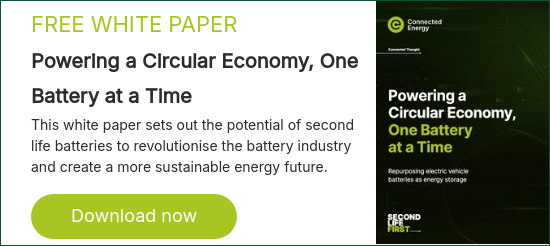
Our recent whitepaper explores the technicalities, safety, benefits, and economic potential of repurposing EV batteries for energy storage. Download today to find out more.

Privacy Overview

This website uses cookies so that we can provide you with the best user experience possible. Cookie information is stored in your browser and performs functions such as recognising you when you return to our website and helping our team to understand which sections of the website you find most interesting and useful.